Updated October 2026
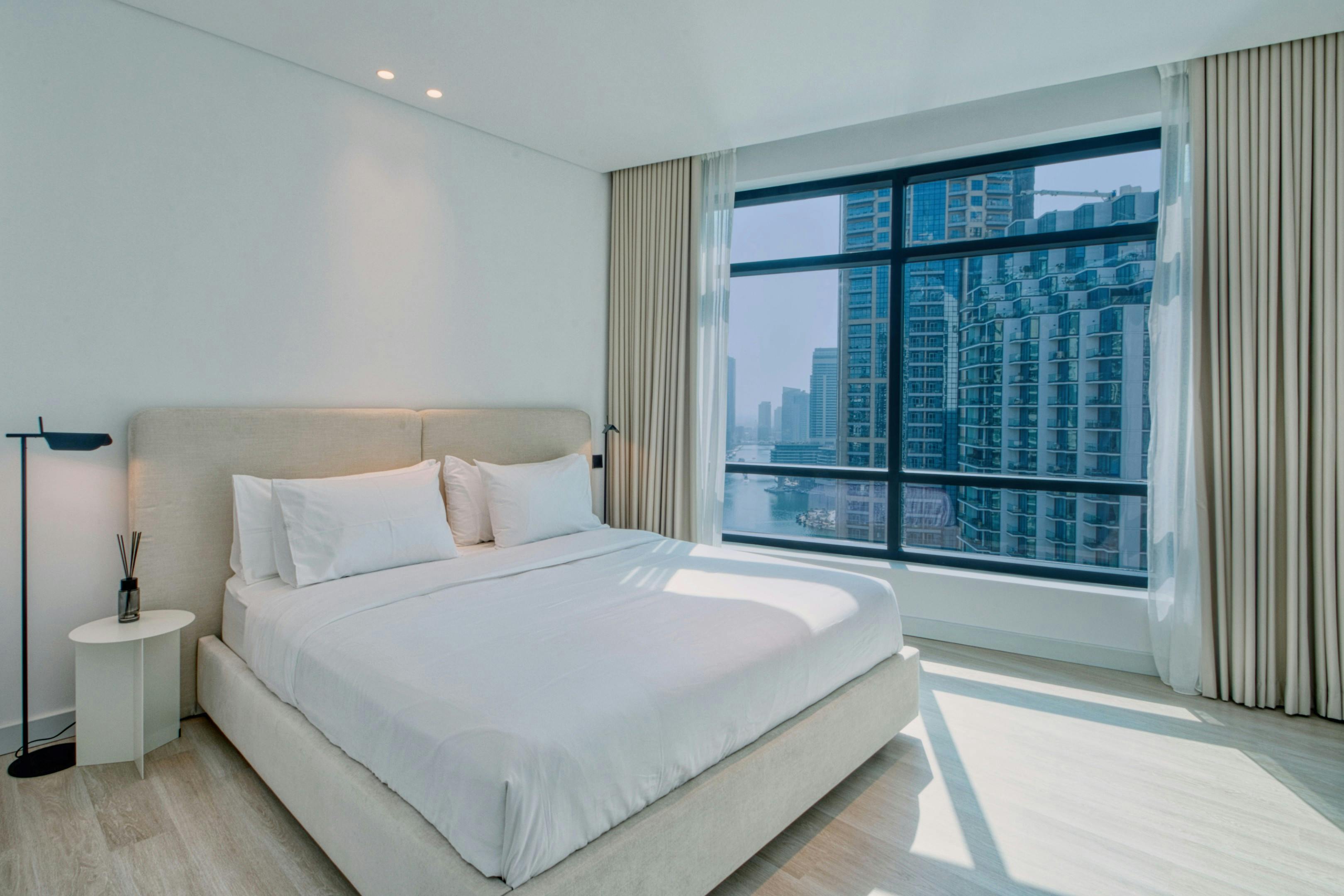
The paint color that makes a small room look bigger isn't always white. What matters is a color's light reflectance value (LRV), a 0–100 scale of how much light a paint reflects, and how much contrast it creates with the ceiling, trim and floor. A dim, north-facing room usually benefits from a warm color with a mid-to-high LRV. A small room with good light can take a deep, low-LRV color and feel cocooning rather than cramped.
This guide explains how to read LRV, the real LRVs of three popular paints, and how to use contrast, not just lightness, to make a small room feel larger.
What is LRV in paint?
LRV, or light reflectance value, measures how much visible light a color reflects, on a scale from 0 (absolute black) to 100 (pure white). Paints with a low LRV absorb more light and look darker on the wall. Manufacturers measure it on a flat, no-gloss sample, according to COAT Paints' Dexter Langkilde, quoted by Homebuilding (September 2026).
Most brands print the LRV on the color's product page or the back of the swatch. It is the most useful number on a paint chip, because two colors that look similar on a small card can behave very differently on four walls.
What do real LRV values look like?
Benjamin Moore lists LRVs on every color page. Three well-known shades show the range:
Chantilly Lace (OC-65): LRV 90.04, a clean white
Revere Pewter (HC-172): LRV 55.05, a warm greige
Hale Navy (HC-154): LRV 8.36, a deep navy
Small differences matter. Homebuilding compares two of COAT's pale teal-blues, Voicenotes (LRV 77.81) and The Good China (LRV 68.68): only about nine points apart, but the first feels noticeably brighter and airier, the second softer and more grounded.
Should you paint a small room white?
Not by default. A high-LRV white reflects the most light, but it only makes a room feel larger if there is light to reflect. In a small room with little daylight, bright white often turns flat and gray, because there isn't enough light for it to glow. Annie Sloan put it simply to Homebuilding: "Don't assume that a small room has to be painted white."
White also shows every edge. A white ceiling against white walls and white baseboards is fine, but white walls against a dark floor and dark furniture can make the outline of a small room more obvious, not less.
How do you choose an LRV for a small room?
Start with which way the room faces and when you use it. Homebuilding's experts recommend a mid-to-high LRV with a warm undertone for north-facing rooms, which get cooler, flatter light, and say south-facing rooms can go lower on the scale because strong daylight stops deeper colors feeling heavy. Annie Sloan's caveat is worth keeping: LRV is a guide, not a set of rules.
How we use it when specifying small spaces:
Dim or north-facing room you want to feel airy: LRV roughly 60–80, with a warm undertone. Very bright whites above 85 can look cold here.
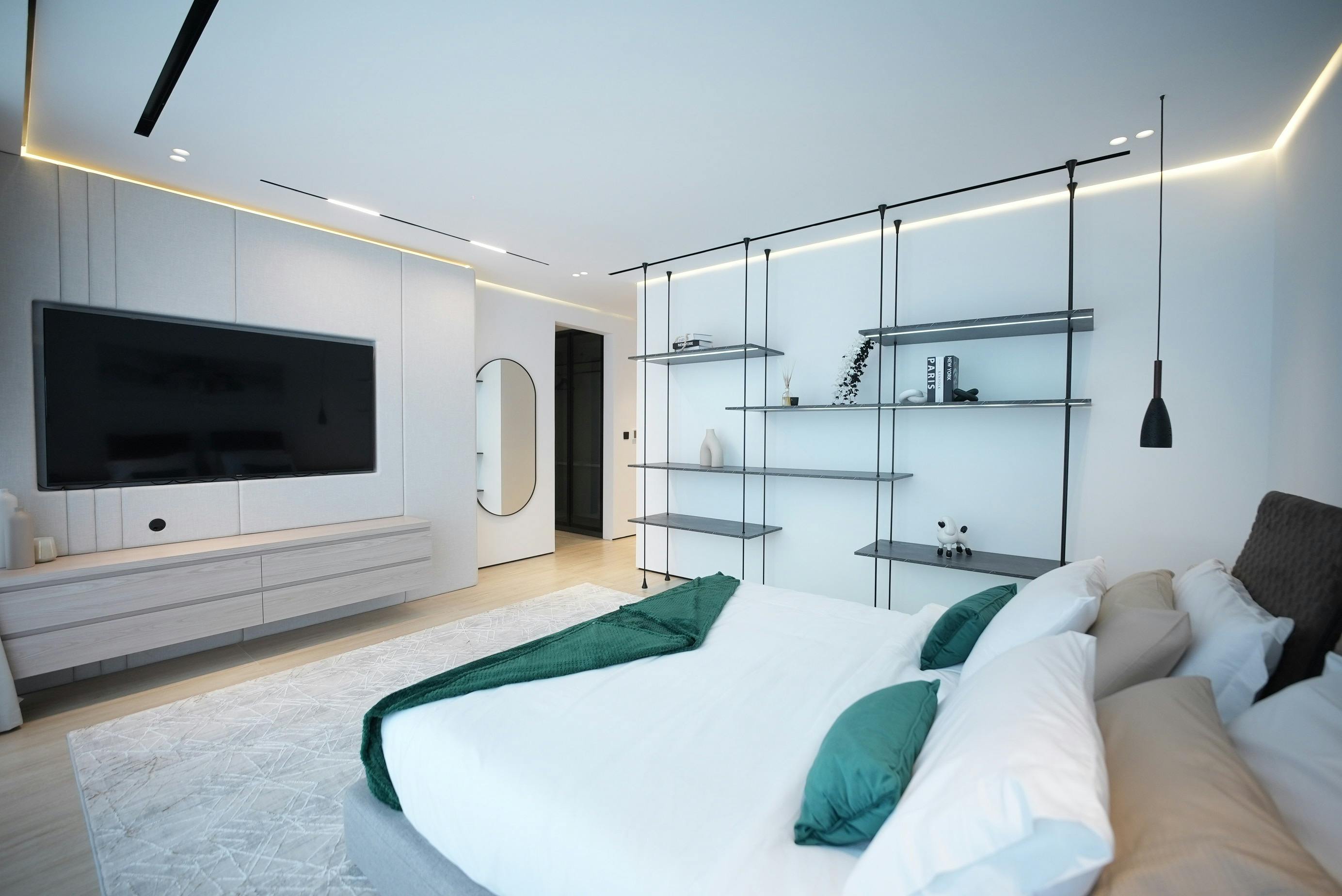
Bright room, or one used mainly at night: you can go deep, LRV under 20. Bedrooms, dining nooks and small home offices suit enveloping color.
Open-plan studio: keep the main walls in one family. Several strong colors in one small space chop it into pieces.
Rental or listing photos: mid-to-high LRVs photograph more evenly, because phone cameras can struggle to capture detail on very dark walls.
These ranges are our working guidance, not a published standard. Always test.
Does contrast matter more than lightness?
Often, yes. The eye reads a room's size from its edges: where wall meets ceiling, floor and window frames. Strong contrast at those edges draws the boundaries clearly. Low contrast blurs them, so the room's limits are harder to read. That is why a small room painted entirely in one mid-tone color (walls, trim and sometimes ceiling), often called color drenching, can feel larger than a room with white walls and dark trim.
Three ways to use contrast in a small room:
Paint the trim the same color as the walls, in a slightly higher sheen for durability.
Take the wall color onto the ceiling in a low room. Or use a paler version of the wall color on the ceiling, rather than stark white, to soften the line between them.
Match curtains to the walls. Floor-length curtains in a similar tone add height without adding a new edge.
Does paint finish change how big a room looks?
A little. Higher sheens reflect more light and are easier to wipe, but they also show every bump and patch in the wall. Matte and eggshell finishes hide imperfections and look calmer, which suits older walls and small rooms where you see surfaces up close. A practical split: matte or eggshell on walls, satin on trim and in kitchens and bathrooms.
How to test paint colors properly
Use large samples, at least A4 or letter size, not small chips.
Put them on two walls: the one facing the window and the one beside it.
Look at them in the morning, late afternoon and at night under your own lamps.
Check your bulbs first. A 4000K bulb makes warm colors look gray, while a 2700K bulb warms cool colors. Our small-apartment lighting guide covers color temperature.
Note the LRV of every sample, so you know whether you're choosing a lighter or deeper option, not just a different hue.
FAQ
What LRV is best for a small dark room?
As a starting point, a warm color around LRV 60–80. Bright whites above 85 can look gray and cold without enough daylight.
Do dark colors make a room look smaller?
Not necessarily. In a room with good light, a deep color applied to walls and trim can blur the room's edges and make it feel larger and more intimate. Dark walls with bright white trim tend to have the opposite effect.
Where do I find a paint's LRV?
On the manufacturer's color page or the back of the paint card. Benjamin Moore, for example, lists it for every color.
Should the ceiling be white in a small room?
Not always. In a low room, painting the ceiling in the wall color, or a lighter tint of it, often feels higher than a bright white ceiling with a hard line.
How Desynte can help
Color is easier to choose once the layout is right. Our free Floorplan Self-Audit includes light and zoning checks for small apartments. For a full palette chosen for your rooms and their light, see our Remote Design service, which includes palette, materials and finishes with a photoreal render.