Updated October 2026
To rent your Dubai apartment short-term, you need a holiday home licence and permit from Dubai's Department of Economy and Tourism (DET, formerly DTCM). The process has four steps: register on the DET holiday homes portal, upload documents and pay, pass an inspection, and display your permit number on every listing. At the time of writing, published guides put the cost at roughly AED 1,500 to register plus AED 300 per bedroom per year, capped at AED 1,200 per unit, but fees change, so confirm them on the DET holiday homes portal before you apply.
This guide covers the steps, the documents and the fees as currently published. It then covers the part legal guides skip: what your unit needs physically before it goes live, and how to furnish it so it books. It is not legal advice. Rules are updated regularly, and DET is the only authority on them.
How do you get a holiday home licence in Dubai?
You apply online through DET. According to Engel & Völkers UAE (August 2026), the steps are: register on the DET holiday homes portal, submit your documents and pay, pass an inspection against DET's standards, then receive a permit number that must appear on all listings. Many owners still search for this as a "DTCM holiday home license"; it is the same permit.
Register on the DET holiday homes portal (hhpermits.det.gov.ae).
Apply and pay: upload documents and pay the licence and permit fees.
Inspection: the unit is checked against DET's safety and quality standards.
Permit issued: you receive a permit number to display on Airbnb, Booking.com and every other channel.
DET also publishes a holiday homes customer journey guide. Read it alongside this article.
Who can apply, and how many units can you register?
Owners, tenants with landlord approval, and companies can apply. Individuals can register up to eight units; beyond that you need a trade licence as a professional operator. That limit is reported consistently by Engel & Völkers, bnbcalc (August 2026) and dubizzle (September 2026).
Tenants need an active Ejari and the landlord's approval (dubizzle).
Whole units only. You can't register individual rooms (bnbcalc).
Villas must be in gated communities of four or more units (dubizzle).
Not eligible: hotel apartments and units whose sale and purchase agreement (SPA) prohibits holiday-home use (Engel & Völkers). Check your SPA and building rules before you buy furniture.
What documents do you need for a DET holiday home permit?
Expect to provide proof of ownership or tenancy, ID, a recent DEWA bill and, in many buildings, an NOC from the owners' association or developer. The list below combines Engel & Völkers and bnbcalc; DET's portal will show the exact list for your case.
Title deed or SPA (or Ejari tenancy contract plus landlord approval, for tenants).
Emirates ID or passport copy.
DEWA bill, less than three months old and in the applicant's name (Engel & Völkers).
NOC from the owners' association or developer, where applicable.
Authorisation letter if a manager applies on your behalf.
Trade licence, for company operators.
Guest liability insurance from a Dubai-licensed insurer (listed by bnbcalc).
How much does a Dubai holiday home permit cost in 2026?
At the time of writing, published guides describe a one-off registration of about AED 1,520 plus an annual permit of AED 300 per bedroom, capped at AED 1,200 per unit. Sources break the fees down differently, so treat the totals below as estimates and check current fees on the DET portal.
Engel & Völkers breakdown (August 2026)
Initial registration: about AED 1,520 (including AED 10 knowledge and AED 10 innovation fees).
Annual permit: AED 300 per bedroom, plus AED 50 classification certificate and AED 10 + AED 10 in knowledge and innovation fees, up to AED 1,200 per unit per year.
Late renewal: AED 200–500.
bnbcalc breakdown (August 2026)
Initial approval AED 100; licence issuance or renewal AED 500.
Permit AED 300 per bedroom, capped at AED 1,200 a year; classification AED 50.
E-programme subscription AED 1,500; inspection AED 300.
Licence valid one year (or up to four years if paid upfront); permit valid one year.
What that means for a 1-bed in year one: about AED 1,890 using Engel & Völkers' figures (1,520 + 300 + 50 + 10 + 10), or about AED 2,750 using bnbcalc's (100 + 500 + 300 + 50 + 1,500 + 300). The gap is why you should price your first year from the DET portal, not a blog, including this one.
What is the tourism dirham for holiday homes?
The tourism dirham is a per-night fee collected from guests and paid to DET. According to bnbcalc and dubizzle, it is AED 15 per occupied room per night for Deluxe holiday homes and AED 10 for Standard, charged for a maximum of 30 consecutive nights per guest and remitted monthly.
Sources disagree on the monthly deadline: Houst says the 15th, bnbcalc says the 16th. Check the date shown in your DET portal account and diarise it.
Standard or Deluxe: what does classification mean for your furnishing?
DET classifies holiday homes as Standard or Deluxe, and the classification sets your tourism dirham rate (AED 10 or AED 15 per room per night). DET's classification criteria are set out in its own guidelines, so check the current version on the portal rather than relying on summaries.
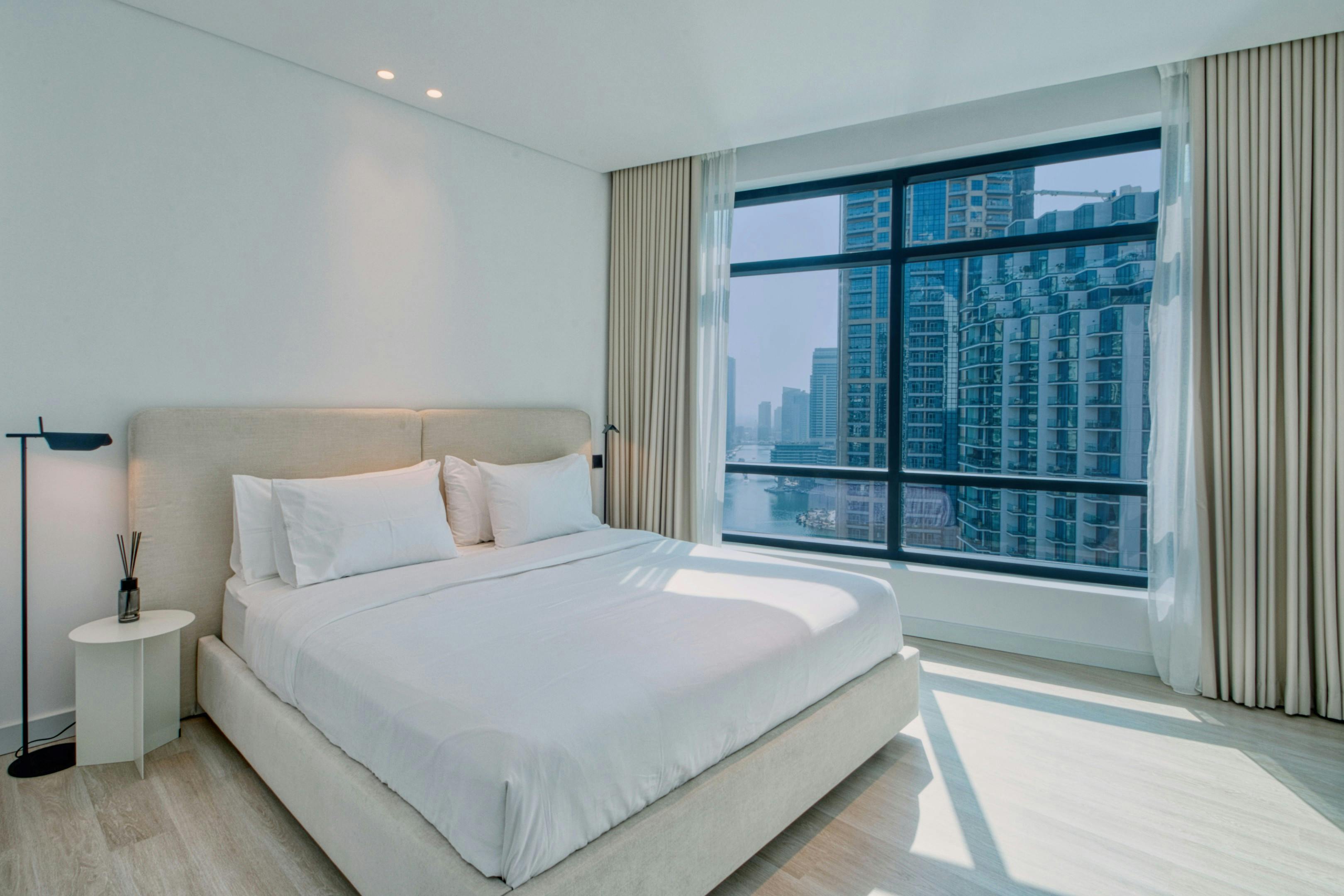
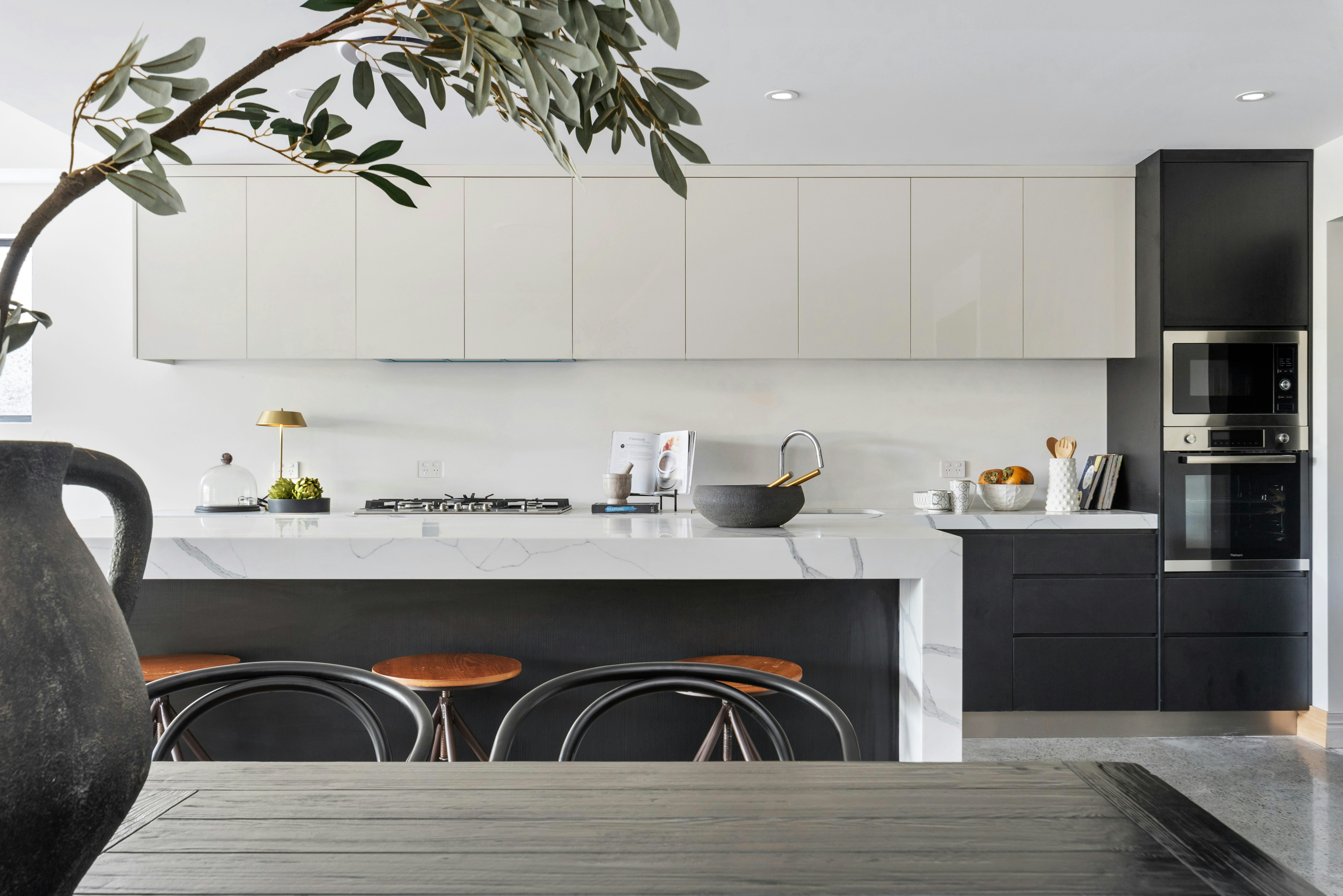
From a design point of view, classification is the floor, not the target. Guests compare your photos with every other listing in the building, not with DET's checklist. The things that move a listing up the search results are the ones guests notice in the first five photos and the first five minutes: the bed, the light, storage for a suitcase, and a kitchen they can cook in.
What must your unit have before you list it?
Before inspection, your unit needs working safety equipment and a full set of guest essentials. Commonly listed items include a smoke detector, fire extinguisher, bed linen, towels, kitchenware and bathroom basics. DET's official standards are the authority; the lists below come from commercial guides and should be checked against them.
Safety and compliance
Working smoke alarm and fire extinguisher, plus clear emergency exit information (Houst, Real Estate Club Dubai).
A bilingual Arabic-English notice board, and utilities supplied to guests at no extra charge (bnbcalc, citing Decree No. 41 of 2013).
Houst also points owners to DET's Sustainability Requirements 2025. Ask DET or your operator which apply to your unit.
Guest essentials
Bed linen and towels (we recommend three sets per bed: one in use, one clean, one in the wash).
Kitchenware: plates, glasses, cups, cutlery, pots and pans, scaled to the number of guests.
Bathroom essentials and a hairdryer.
If you'd rather work from a complete, quantified list, our Short-Term Rental Furnishing Kit (USD 29) has room-by-room checklists for studios, 1-beds and 2-beds, linen quantities, safety items and an Excel budget tracker.
How should you furnish a Dubai holiday home so it photographs and rates well?
Furnish for the photo and the stay at the same time: a hotel-standard bed, layered lighting, durable washable fabrics, real storage and one memorable feature per unit. Dubai is a competitive market. AirDNA data dated 4 October 2026 shows 20,438 active listings, an average daily rate of USD 179 and 69% occupancy (AirDNA).
Our checklist for small units:
Plan the layout before you shop. In a studio like the 385 sq ft (35.8 m²) unit we designed at Marina Diamond Tower, the bed position decides everything else.
Buy the best mattress you can afford. It is the single item most likely to appear in reviews.
Light every corner. Ceiling light, plus lamps, plus under-cabinet light. Photographers shoot with every lamp on.
Choose performance fabrics and removable covers in mid-tones, not white.
Give guests somewhere to put a suitcase and hang clothes. Small units fail on this constantly.
Add one signature moment: a statement headboard, wallpaper wall or view-facing seat. It becomes your hero photo.
Deciding between a ready-made package and a designed layout? See furniture packages vs hiring a designer. Still weighing short-term against a furnished long let? Read furnished vs unfurnished rentals in Dubai.
What happens if you operate without a holiday home permit?
Operating without a permit can lead to fines, and platforms check permit numbers. According to bnbcalc, fines are AED 5,000 for operating without a licence and AED 20,000 for operating while suspended, with repeat violations doubling up to AED 100,000. bnbcalc also reports that Airbnb, Booking.com and Vrbo check permit numbers before a listing goes live.
Penalty amounts are set by DET and can change. Confirm the current schedule with DET before relying on any figure.
FAQ
How much is the holiday home permit fee in Dubai?
At the time of writing, guides list about AED 1,520 for initial registration plus AED 300 per bedroom per year, capped at AED 1,200 per unit. Some breakdowns add an e-programme subscription and inspection fee. Check the DET portal for current fees.
Can a tenant run a holiday home in Dubai?
Yes, according to dubizzle, if the tenant has an active Ejari and the landlord's approval. Building rules and your tenancy contract may add restrictions, so check both first.
How many holiday homes can I register as an individual?
Up to eight units, according to Engel & Völkers, bnbcalc and dubizzle. Beyond that you need a trade licence as a professional holiday home operator.
What is the tourism dirham for holiday homes?
AED 15 per occupied room per night for Deluxe and AED 10 for Standard, charged for up to 30 consecutive nights per guest, according to bnbcalc and dubizzle. You collect it from guests and pay it to DET monthly.
Can I rent out a single room as a holiday home?
No. According to bnbcalc, DET holiday home permits cover whole units only. If you want to share your home with guests, ask DET whether another permit type applies.
How Desynte can help
Desynte gets units permit-ready and photo-ready without you managing suppliers. With Design, Sourcing & Installation (UAE turnkey, from AED 14,000 for a 1-bed), we design the layout, place orders on your behalf (you pay suppliers directly), manage deliveries and returns, supervise our partner contractor for any surface works, then assemble, style and hand over. Furniture, materials and fit-out are billed separately at cost.
If you already have an operator handling the permit, Design & Sourcing (from AED 9,000) gives you the design, specifications and an itemised BOQ to buy from. See turnkey pricing, or message us on WhatsApp at +971 58 572 9525.